
The problem
Picture a patient whose oxygen has been slowly dropping for 40 minutes, while the next scheduled check is still hours away. Continuous wireless monitoring is linked to nearly 3× lower odds of ICU transfer or in-hospital death (Rowland et al., JMIR 2025), but hospitals face four problems that feed into each other:
- Monitoring gaps: conditions change in seconds, and checks happen every 30–45 minutes.
- Staff overload: nurses can’t simply do more manual checks.
- Unreliable networks: shared hospital Wi-Fi congests exactly when it matters, and static allocation can’t adapt.
- Privacy risk: pooling raw vitals in the cloud creates a target for breaches and a HIPAA burden.
The design
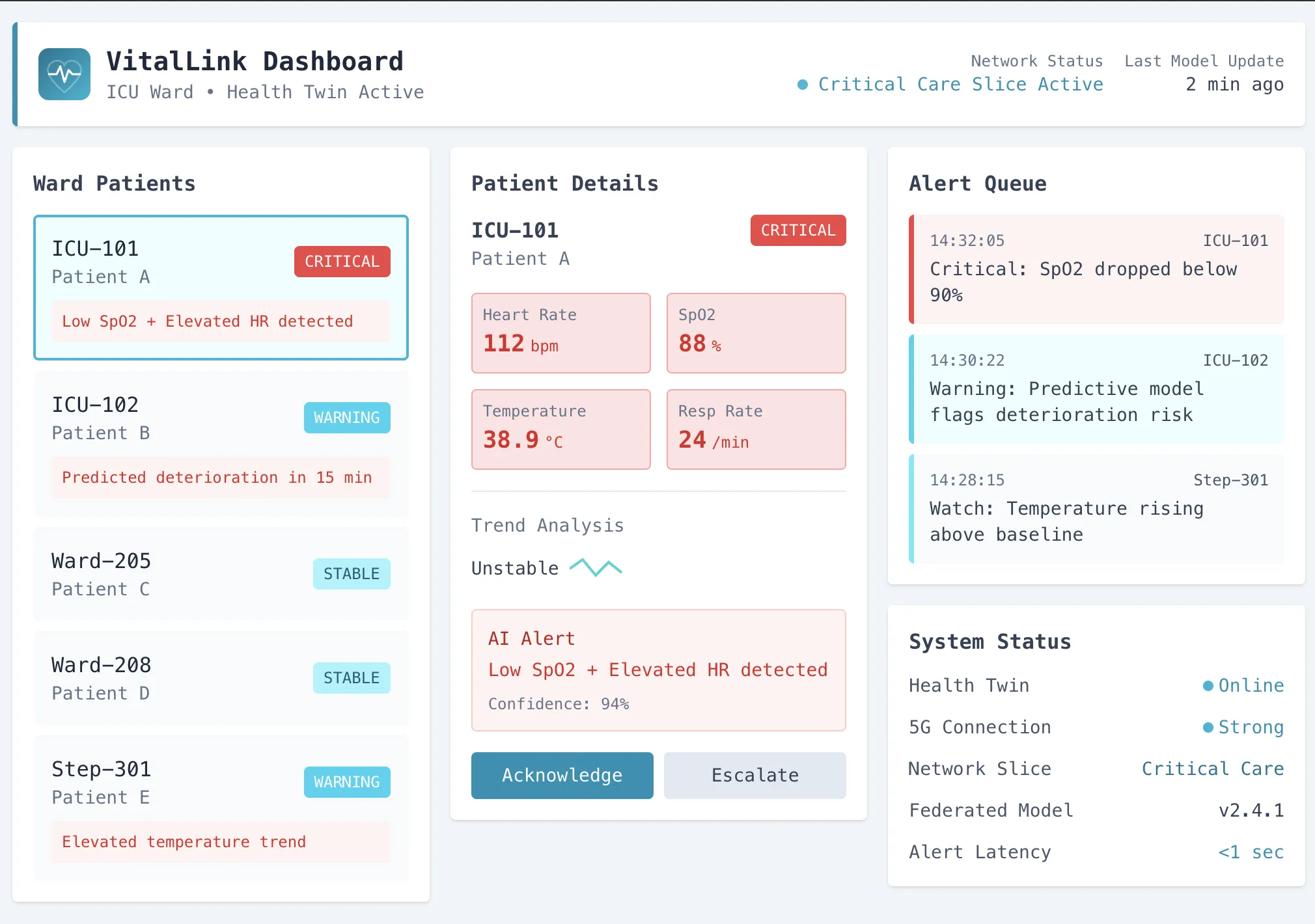
- A Health Twin in every ward. It’s a mini-PC that acts as the ward gateway and edge computer. It cleans up and stores recent vitals, runs anomaly detection and short-term forecasting, and raises alerts without a round trip to the cloud. If the central layer goes down, the ward keeps working.
- A simple dashboard for nurses. Patient status, trends and a prioritized alert queue. Alerts have to be acknowledged or escalated, so none can quietly disappear.
- Federated learning across wards. Each ward trains locally and sends only model updates. A central on-prem coordinator averages them (FedAvg) and sends the improved model back, so every ward learns from the others without pooling patient data.
- Network priority when it’s scarce. A private 5G network gives critical-care traffic its own slice. When capacity is tight, wards bid for priority by clinical urgency, with a fixed priority order as a deterministic fallback. Verizon ThingSpace manages each ward gateway’s connection.
Making it adoptable
We designed it to be cheap to pilot:
- No new bedside hardware. It plugs into the monitors the hospital already has.
- One managed connection per ward, not a SIM per device.
- About $1,000–3,000 to set up three wards, using off-the-shelf Intel mini-PCs and an open-source software stack. After that, the main monthly cost is connectivity.
We also built the business case: a per-ward monthly subscription, bundled connectivity and one-time onboarding, starting with a single ward and expanding hospital by hospital. In the final round I presented the impact and the case for building it on Verizon.