I spent the summer on the Marketing Operations team treating each AI project as an engineering problem first. Prompting a model was the easy part. The value came from what I built around it: rate limits and access control, parallel API calls, schemas for structured input and output, and version control throughout.
The signal-scoring engine
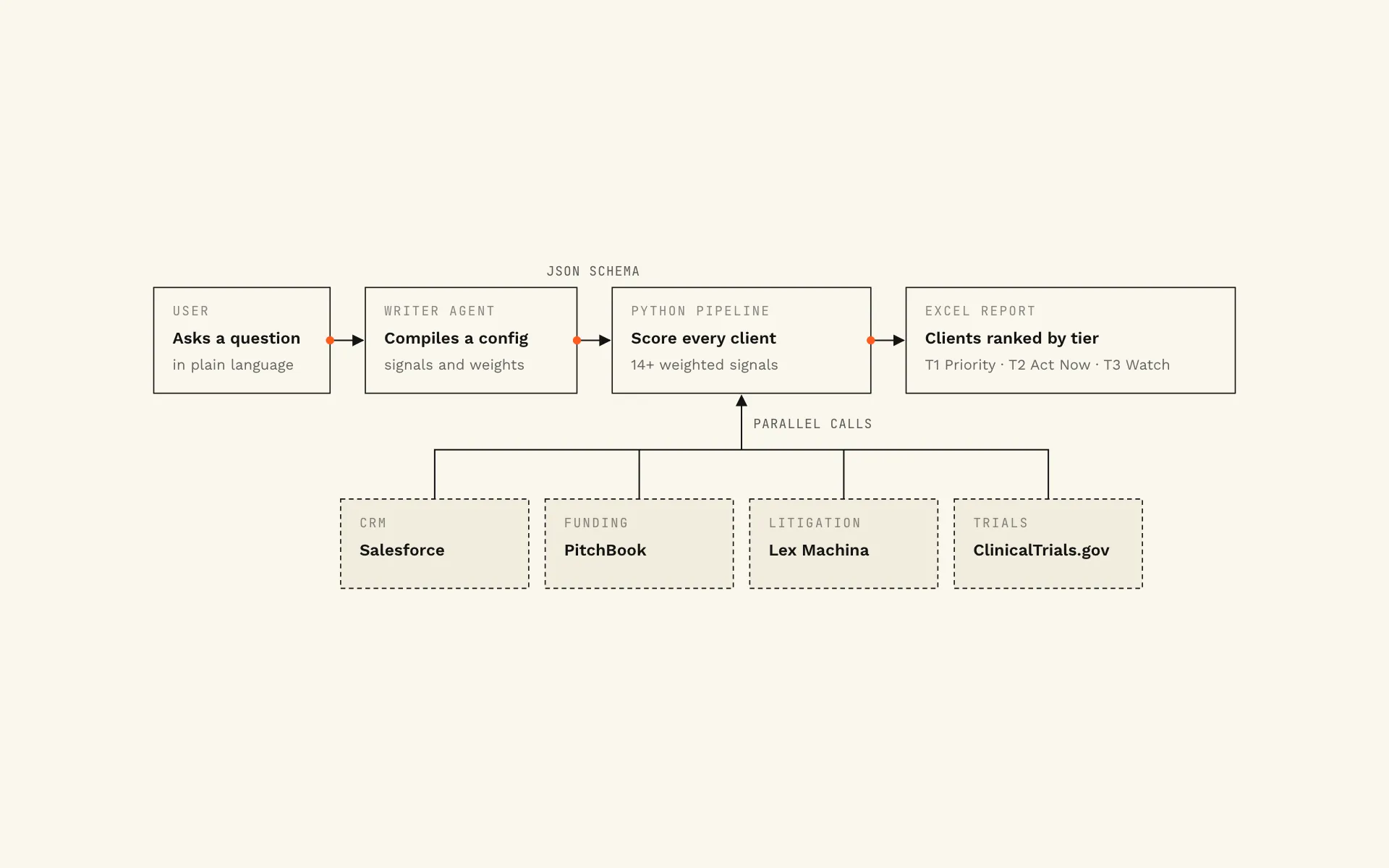
Partners want to know which existing clients are about to need more legal work. I took a hardcoded Python script written for one practice area, Life Sciences, and turned it into a configurable pipeline that works for any of them.
- The agent writes a config, not an answer. A Writer agent turns a request like “rank our AI clients by cross-sell urgency” into a JSON-schema scoring configuration. The Python pipeline validates that config and does the scoring, so results are repeatable and explainable instead of whatever the model says that day.
- 14+ signals. Funding stage (with separate signals for Series A through D+, to catch companies at peak timing), valuation, priority investors, relationship strength, gaps in the services a client already uses, active litigation and clinical-trial phase. Default weights shift based on what the user asks for.
- Parallel calls. The CRM and third-party APIs are called concurrently, and the output is an Excel report ranked into three tiers: Priority, Act Now and Watch.
I validated it with a live production run on real clients, then packaged it as a Writer skill with documentation and a configuration guide so other teams could run it.
Contract intelligence pipeline
A pipeline from the firm’s document management system, iManage, into Databricks. It pulls contracts, extracts their key terms and writes a briefing for each, and lands everything as tables people can query. I adapted a standalone parsing script into something that runs top to bottom on a fresh Databricks cluster with no manual setup.
- Rules first, then the model. Reliable fields (document ID, client, matter) come straight from iManage metadata. Deterministic code pulls contract type, counterparty, effective date, auto-renewal and notice windows from the text. It also builds a pricing model that tells flat, escalating, per-seat and per-hour pricing apart, and ignores dollar figures that aren’t prices, like liability caps. Only then does a Claude model, hosted on Databricks, write a briefing: a summary, key terms and obligations, and critical dates.
- Real documents. It parses DOCX and PDF files in memory, keeps tables that plain text extraction would flatten, and tells signed contracts apart from unsigned templates.
- No secrets in code. Credentials live in Databricks secret scopes, and API tokens are cached between calls.
A live run on real signed agreements (SaaS, master service and enterprise vendor contracts) correctly picked out counterparties, contract values and renewal-notice deadlines.
Smaller systems
- Case briefings by email. An attorney forwards a complaint to the library team’s inbox. A Writer agent picks up the email, pulls the case from CasePortal, adds litigation data from Lex Machina, and replies with the key case intelligence in under 5 minutes.
- 50% faster automations. I cut end-to-end time in half on a receipt-analyzer workflow (ClickUp to Outlook) and a company-profile PDF generator, by running independent API calls in parallel and using structured schemas to order the ones that depend on each other.
- A data model for PitchBook. A normalized entity-relationship model over 44 tables of PitchBook data, with the keys defined so enriched data can flow back into Databricks. For testing, I built a 1,000-company sample across 20 related tables in Spark SQL, with no orphaned rows, deduplicated to one row per company.
- Similar-client search. It finds past clients that look like a new prospect by joining PitchBook, Salesforce and Litera Foundation data and scoring shared attributes with a rule-based Python model.
- Agent tools. I made the Marketo API callable by a Writer agent, for creating alerts and editing email templates, and helped test and finish a skill for asking the PitchBook data questions in plain language.