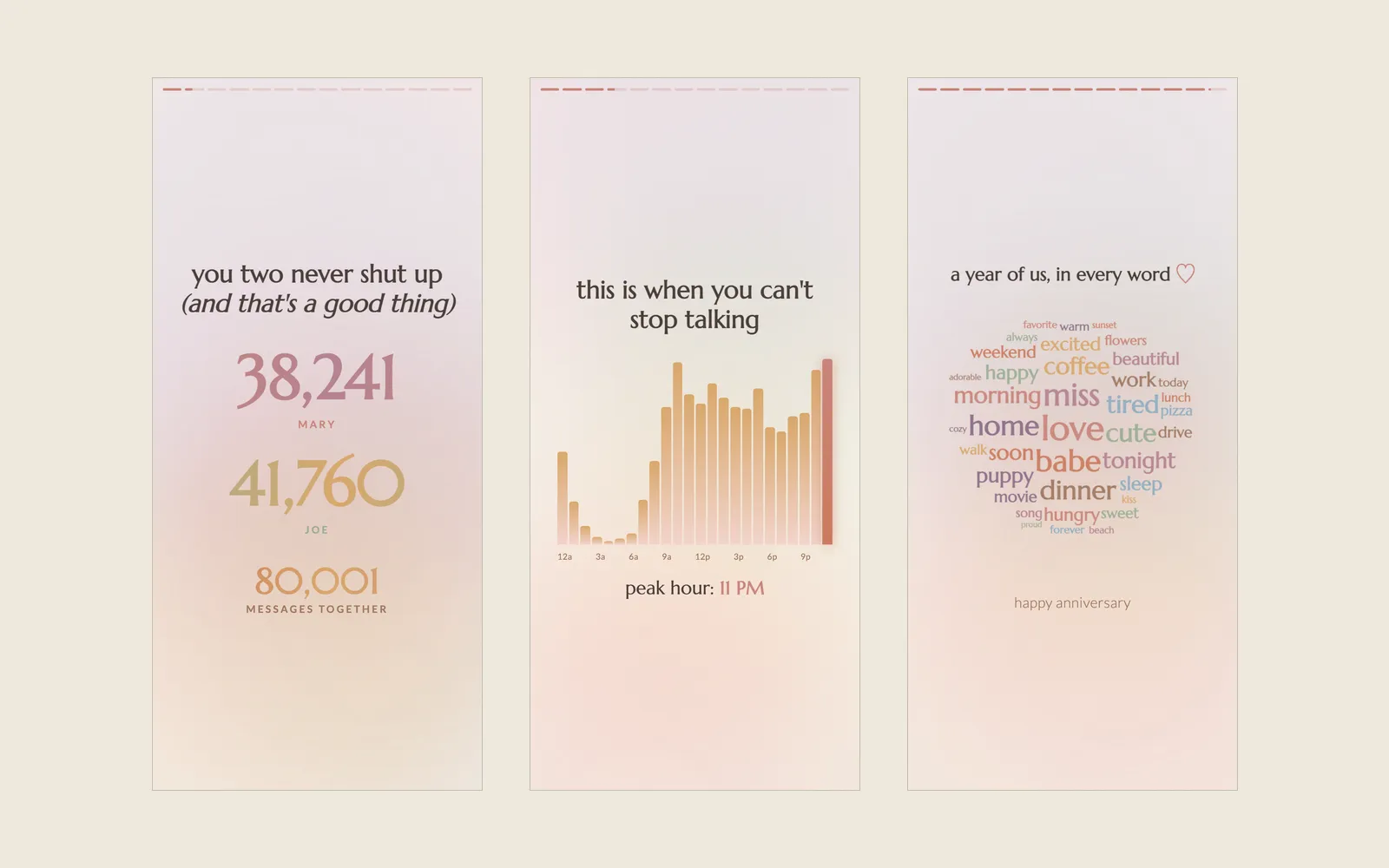
Run python3 wrapped.py, enter a phone number and two names, and it opens a full-screen story in the browser. The slides cover total messages, “I love you” count, the hour you text most, your busiest day, the longest run of texts without a reply, average reply time, top emojis, phrases only you two say, and a heart-shaped word cloud.
How it works
- Reading the texts. iMessage stores everything in a SQLite database on the Mac. The script opens it read-only, finds the person’s handles, and filters to the last year. It drops tapback reactions, so the numbers only count messages someone actually typed.
- Recovering the text. Newer versions of macOS often leave a message’s text column empty and keep the words inside a binary blob instead. I wrote a small decoder that pulls the plain text back out of it.
- Fair stats. Reply times ignore rapid-fire back-and-forth, so a quick exchange doesn’t make the average meaningless. Common filler words are filtered out of the phrases and word cloud.
- The slideshow. One self-contained HTML file with no framework. It auto-advances, counts the numbers up, and supports tapping and arrow keys.
Privacy
Everything stays on your computer. The script only writes aggregate stats to one local file, and that file is in .gitignore so it can’t be committed by accident. A fresh clone shows made-up sample data, which is what the screens above use.